

Intake
The AI system is clarified through conversation with the Risk Agent, or built automatically from your project documentation.
Observability · Verification · Explainability · Risk assurance
Turn AI from a possible unmanaged liability into a managed, auditable asset.
Grounded in
AI adoption is racing ahead of risk and governance. These are the six places teams get stuck, and every one of them is a question an auditor will ask.
Which AI systems carry which risks is unknown across the organization.
The documents auditors want are built by hand, scattered, and re-done each time.
Mapping many frameworks at once: CSET AI Harm Analysis, ISO 42001, NIST AI RMF and the MIT AI Risk Database.
Risks fall between departments, and actions are not tracked to completion.
With limited resources, which risk to tackle first is not obvious.
Assessments are tied to a single AI vendor and are not portable.
Common AI harms are grounded in documented, real-world incidents. OverAI draws this knowledge from authoritative public sources rather than from opinion.
Catalogued risks. Every discovered risk resolves to a subdomain of this tree.
Tangible and intangible consequences are classified separately and scored separately.
The NIST-mapped mitigation catalogue every recommendation is selected from, each with its action identifier.
Risks are matched against documented incidents rather than estimated by a model.
Unfair outcomes for sub-groups.
Untrue, unreliable decisions.
Improper handling of personal data.
Automated decisions no one can audit.
One guided workflow turns any AI project into identified risks, prioritized fixes and audit-ready evidence, summarized in a single Mitigation Progress Score.
What the platform does
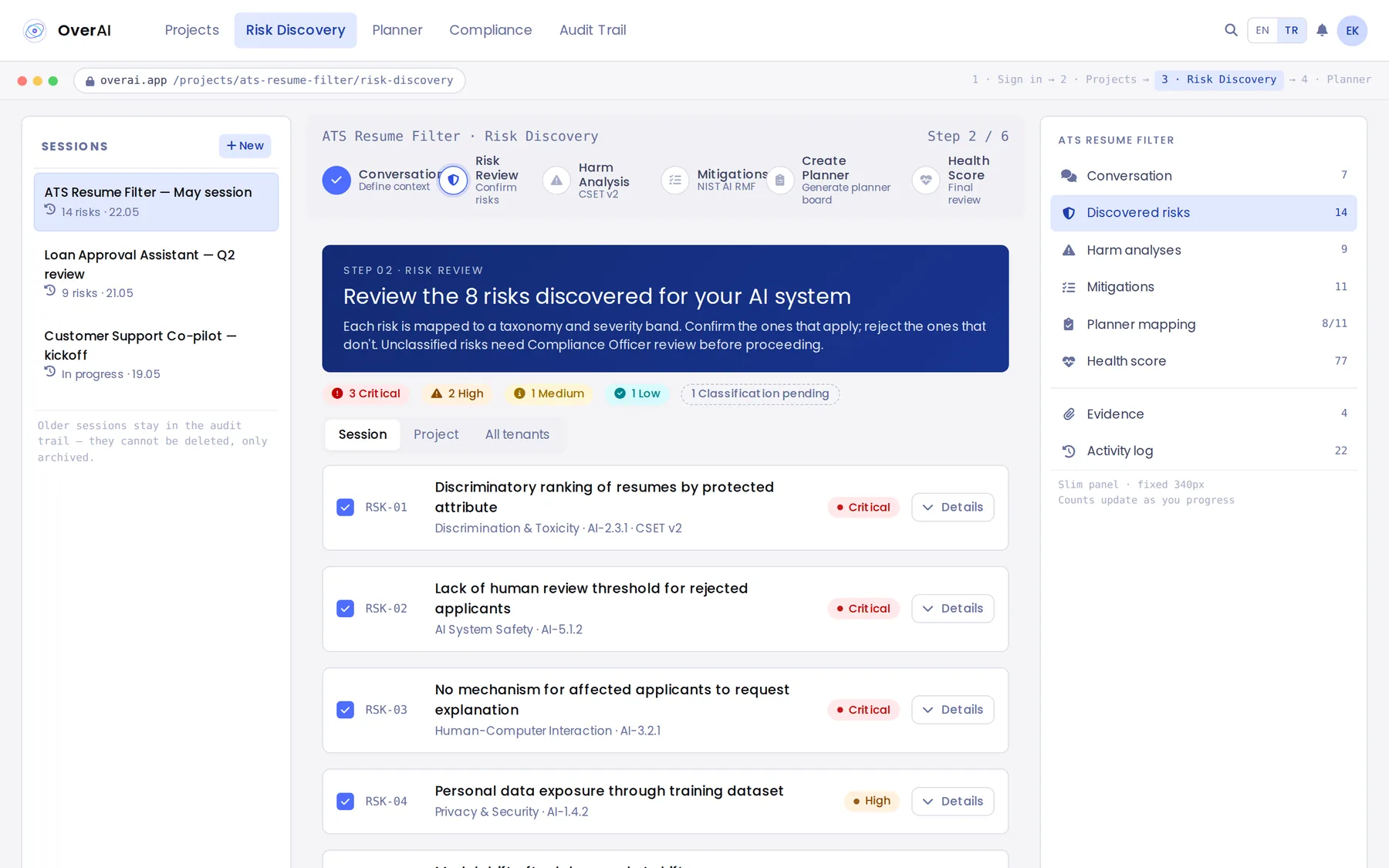
The project description is matched against the MIT AI Risk Repository.
Every risk lands in a domain and a subdomain, with a severity band.
Each risk is mapped to the real-world harm it could cause.
Harm is scored so the list can be ordered by what actually matters.
Controls are selected for each risk and harm pair, then prioritized.
Controls become owned tasks, and completion is what moves the score.
The risk methodology is adaptable to tailor-made enterprise frameworks and to the ISO 31000 standard set.
Layer 1 · the risk
The foundation layer. The MIT AI Risk Repository identifies and classifies the underlying AI risk, and it is continuously updated.
The underlying risk is identified across 7 domains, 24 subdomains and 1,600+ catalogued risks. Risks come in scored.
Each risk is classified by its cause: the entity, intent and timing behind it, following the MIT repository structure.
Risks are organised across 7 domains and 24 subdomains, giving every project a consistent classification.
MIT refreshes the repository continuously, so we extend our own systematic layer and feed the risk agent as it evolves.
Three ISO/IEC standards shape the pipeline, each with a defined scope and a clear place in it. ISO/IEC 42001 is the framework the platform runs against today. ISO/IEC 23894 and 42005 are on the roadmap.
ISO/IEC 23894
Guidance on AI-specific risk management: identifying, analysing and evaluating risks across the AI lifecycle.
Risk identificationAligns with the MIT risk taxonomy layer.
ISO/IEC 42005
AI system impact assessment: how AI systems affect individuals, groups and society, and how to document it.
Harm identificationAligns with the CSET harm-mapping layer.
ISO/IEC 42001
AI management system (AIMS): governance, controls and continual improvement for responsible AI.
Mitigation and controlAligns with the NIST AI RMF control layer.
The MIT causal taxonomy classifies each AI risk along three factors. Used together, they describe the circumstances in which a risk arises.
Entity
Whose decision or action caused it?
Intent
Was the outcome expected?
Timing
When did it occur?
The MIT domain taxonomy classifies AI risks into seven domains and 24 subdomains, giving every project a consistent, shared classification.
Unfair treatment, harmful content and unequal performance across groups.
Leaked or inferred sensitive data and exploitable system vulnerabilities.
False information and erosion of a shared, consensus reality.
Disinformation, fraud, cyberattacks and weapon development at scale.
Overreliance, unsafe use and loss of human agency and autonomy.
Power concentration, inequality, devaluation of effort and environmental harm.
Misaligned goals, dangerous capabilities, lack of robustness or transparency.
Layer 2 · the harm
The harm layer. CSET, the Center for Security and Emerging Technology at Georgetown University, and its AI Harm Framework map each identified risk to its potential real-world harm, linking AI behaviour to tangible and intangible impact.
Each identified risk is mapped to its potential harm, so the impact is made explicit rather than assumed.
A harm taxonomy links AI behaviour to concrete real-world consequences for people and organisations.
Captures both measurable and non-measurable impact, so the picture is complete rather than only what is countable.
Grounded in CSET's public harm framework, so every harm mapping stays defensible and auditable.
Layer 3 · the control
The control layer. The NIST AI Risk Management Framework turns each identified risk into practical, testable controls, fed by the MIT mitigation database.
Each risk becomes practical, testable controls, organised by the functions of the NIST AI RMF.
Controls are fed by the MIT mitigation database, which MIT keeps up to date and which we extend ourselves.
Mitigation starts at 0 for every risk and rises only as real controls are actually completed.
Every control is backed by audit-ready evidence at every step of the pipeline.
Across the mitigation library, 831 controls fall into five types. The mix is weighted toward procedural and governance controls, not just technical fixes.
Evidence
AI risks are not theoretical. The AI Incident Database documents real-world AI incidents, and MIT places them into the risk taxonomies.
The public database documents more than three thousand real-world AI incidents, evidence that these risks actually occur.
MIT places each incident into the risk taxonomies, so cases line up with the domains we identify.
Matched incidents turn an abstract risk into evidence, and they are what the project context variables are derived from.
Drawn from the open AI Incident Database at incidentdatabase.ai, a public and continuously growing source.
Roadmap Each risk will be linked to concrete examples of real incidents from the AI Incident Database, in line with the roadmap.
You describe the project. The platform advances each step, grounded in authoritative sources, and the whole chain stays on record and traceable back to its origin.
The AI system is clarified through conversation with the Risk Agent, or built automatically from your project documentation.
The project description is matched to subdomains of the MIT AI risk taxonomy. Every risk arrives with a code and a severity band.
For each risk the possible consequences are bound to CSET categories, with the causal pathway and reversibility written out.
Controls matching the risk and harm pair are selected from the rule tables, each carrying the identifier of the NIST action it comes from.
Context is derived from documented real-world cases rather than estimated, so two analysts scoring the same system land in the same place.
Accepted controls become tasks with an owner and a status. A rejected control stays on record with its reason.
The project reduces to a single number. As tasks complete the score is recalculated and every snapshot is kept.
The result: a single Mitigation Progress Score. It rises only as real mitigations are completed, which is what honest by design means here.
Severity, harm type and control matching are bound to rule tables. The language model relates your project to those tables, it does not decide the score on its own. The methodology is adaptable to bespoke enterprise frameworks and to ISO 31000.
One project is a start. The portfolio view is what the board actually asks about, and it is built from the same numbers rather than assembled for the meeting.
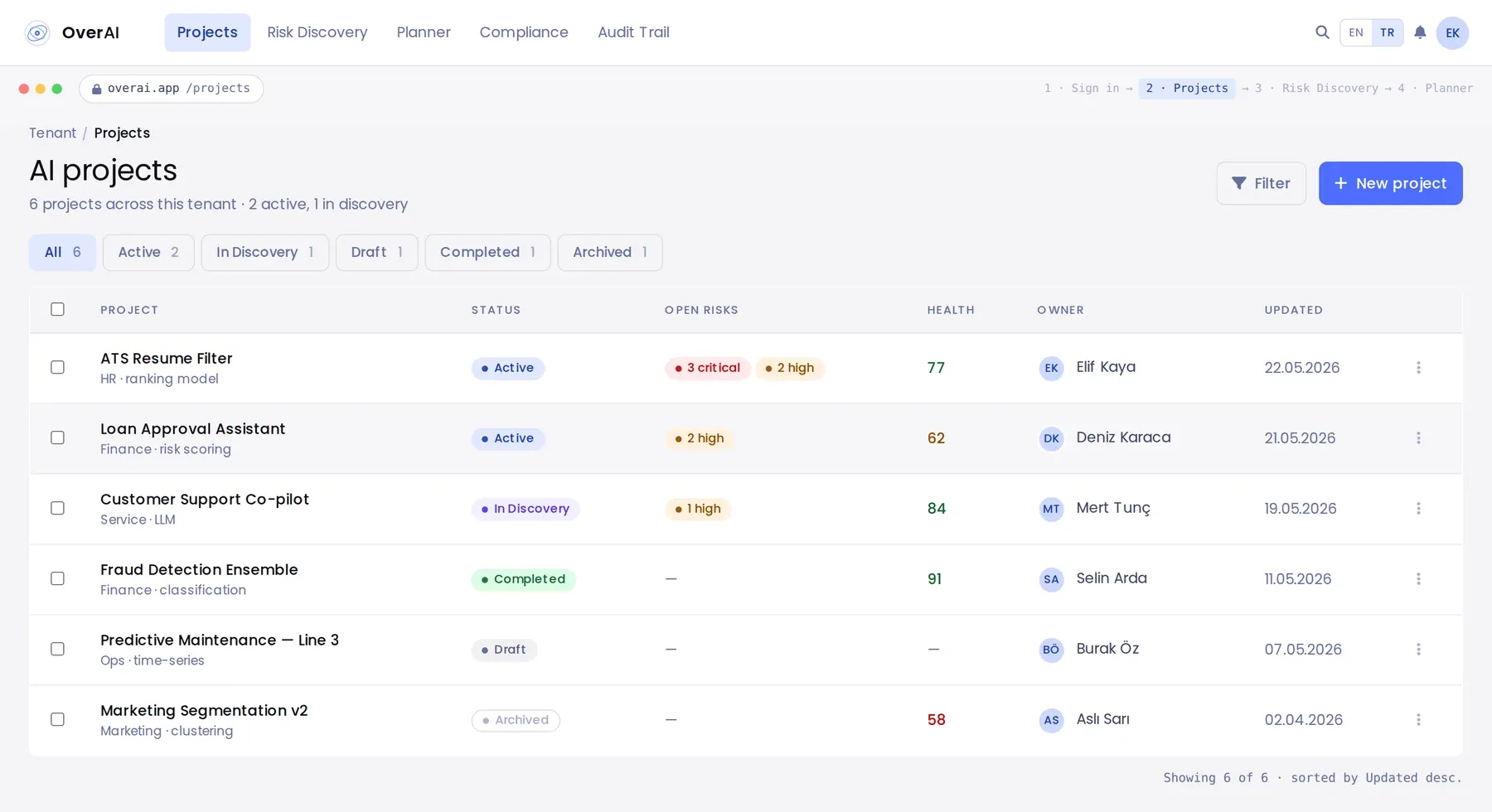
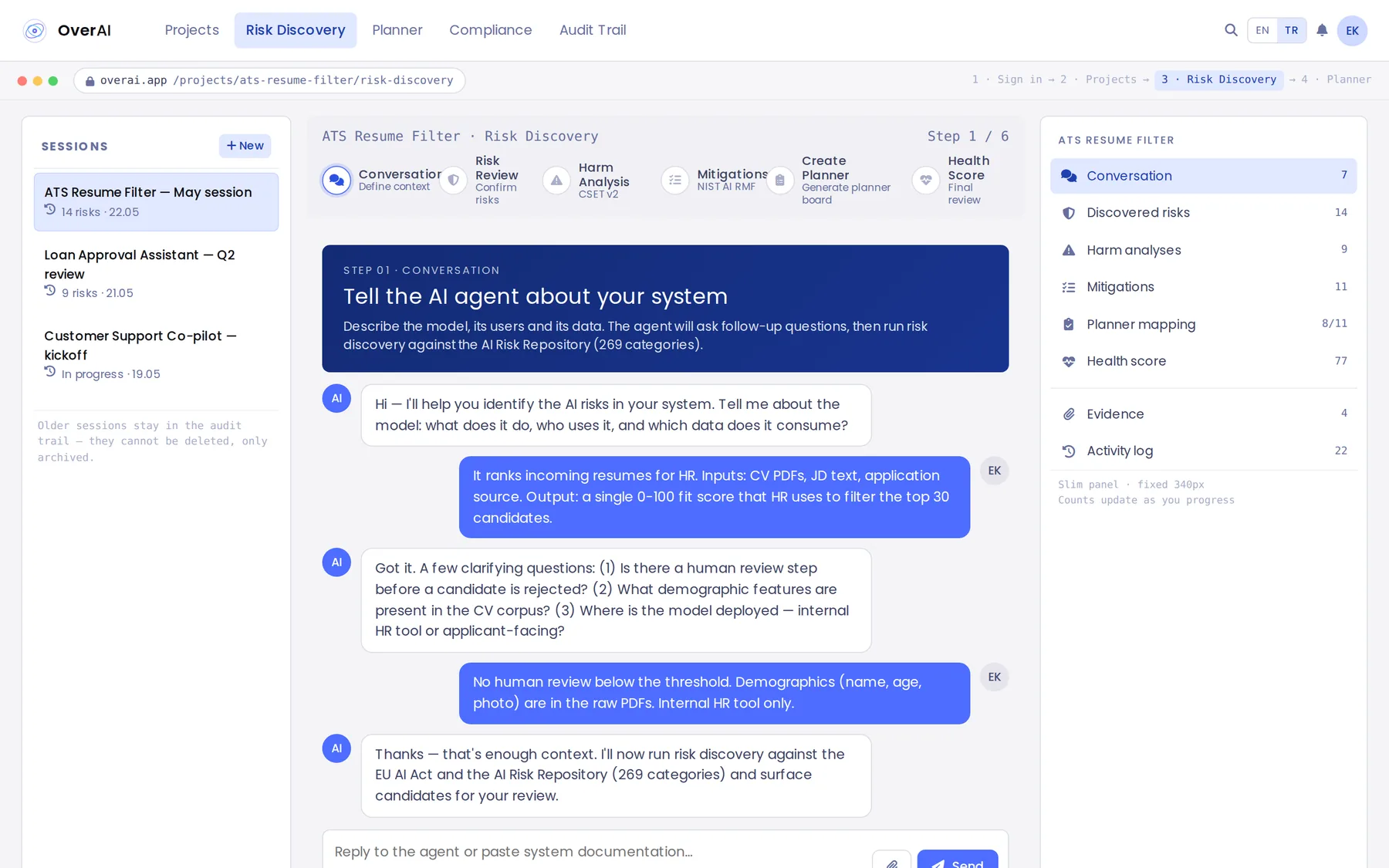
There is no form to learn. The agent asks what it needs, and every answer it collects stays attached to the record it produced.
Most tools either govern AI generically or perform AI tasks. OverAI grounds every result in authoritative, public standards, which is what makes the output defensible.
MIT AI Risk Repository, CSET harm taxonomy, NIST AI RMF and the MIT mitigation database.
Every risk is matched to documented cases in the AI Incident Database.
The core intellectual property is legal expertise expressed as a mapping algorithm.
A low-cost, flexible subscription rather than an expensive, rigid deployment.
A unified agentic platform covering risk discovery, harm identification, mitigation planning, task management and audit-ready reporting.
Capability
OverAI applies across regulated industries: telecom, banking, healthcare, media and beyond.
Churn and credit or fraud scoring, generative customer assistants and network optimization, governed for fairness, privacy and explainability.
AI credit scoring and limit decisions, with bias testing and a human appeal path built in.
Diagnostic AI monitored for accuracy, sub-group fairness and human oversight.
Generative content with fact-checking, plagiarism and reputational controls.
Sample use cases and industries where OverAI can perform. The list is illustrative, not exhaustive.
Bring one AI system and we will take it end to end, from the first conversation to a Mitigation Progress Score, with your own data and your own sector context.